

Google Ads can scale revenue fast in Dubai, but most businesses do not lose money because Google Ads “doesn’t work.” They lose money because they choose the wrong management model, launch with weak tracking, and optimize for clicks instead of qualified leads.
This guide is built for decision-makers who want a practical answer to one question: what should you actually pay for Google Ads management in Dubai in 2026—and what should that fee include?
Quick Context
If your business is comparing agencies right now, this is a buyer guide focused on cost logic, service scope, and ROI safeguards—not generic ad tips.
TL;DR
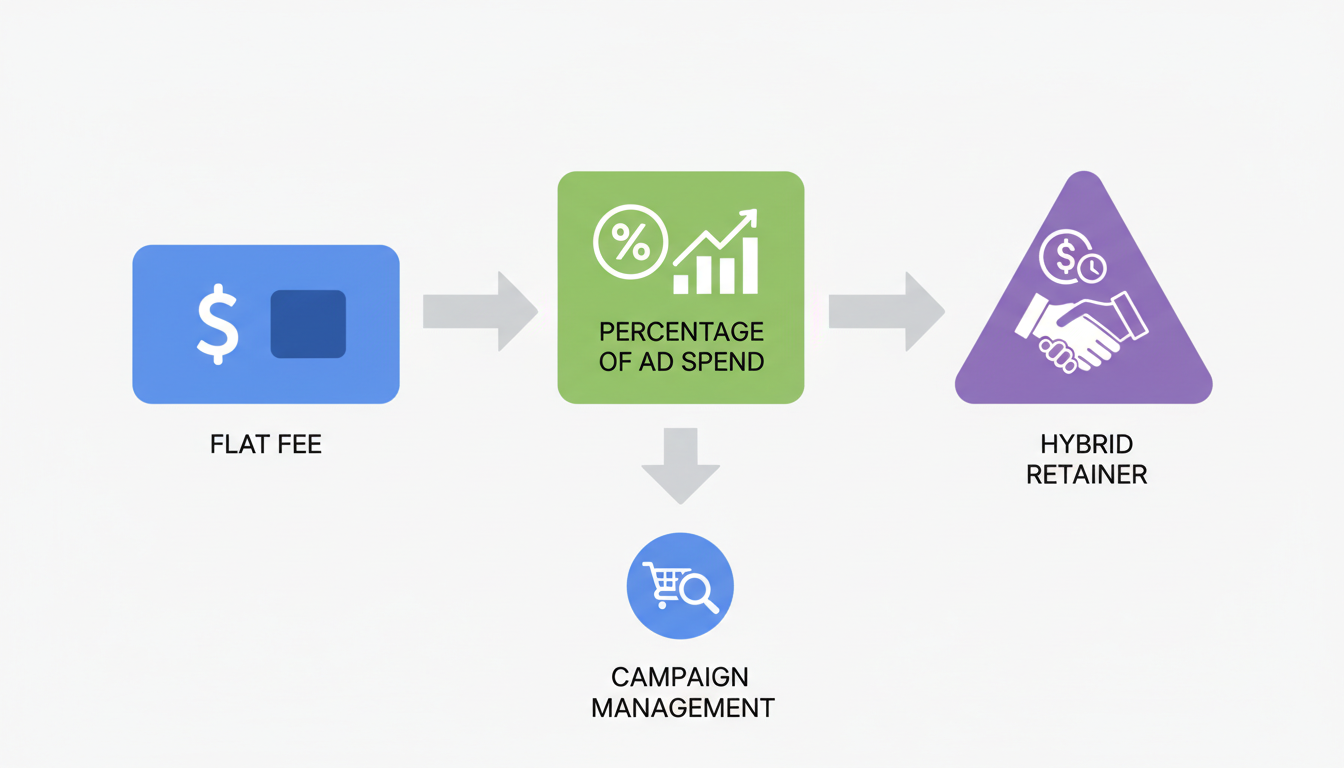
- In Dubai, management pricing is usually structured as flat fee, % of ad spend, or hybrid.
- The best model depends on your stage, tracking maturity, and lead quality goals.
- Cheap retainers often fail on tracking depth, search-term hygiene, and optimization cadence.
- Good pricing conversations include scope, KPI ownership, reporting cadence, and exclusions.
- The right agency fee is the one that protects qualified lead economics, not vanity metrics.
Why “Cheap” and “Expensive” Are Both Misleading Without Scope
AED figures alone tell you almost nothing. Two agencies may quote very different retainers while promising the same outcome. The difference usually hides in execution details:
- How granular conversion tracking is
- Whether search-term filtering is done weekly or monthly
- How quickly ad copy and landing-page hypotheses are tested
- How budget shifts are made across campaigns based on lead quality
- Whether reporting is cosmetic or tied to commercial outcomes
So before you ask, “Is this quote high?”, ask: what exactly is being managed?
The 3 Common Pricing Models in Dubai
1) Flat Monthly Retainer
You pay a fixed monthly fee for defined services. This model is clean for forecasting and easiest for finance teams.
Best for: businesses with stable spend, stable offer mix, and clear campaign scope.
Risk: if scope expands (new markets, new offer lines, heavy testing), fixed retainers can become under-serviced unless re-scoped.
2) Percentage of Ad Spend
The management fee scales with media spend. This can be efficient when campaigns are actively scaling and complexity increases with spend.
Best for: growth phases where budgets are expected to rise materially over 1–2 quarters.
Risk: misaligned incentives if spend growth is not tightly linked to lead quality or revenue outcomes.
3) Hybrid (Base + Variable)
A base retainer covers strategic/operational work, and a smaller variable component adjusts with spend or milestones.
Best for: businesses that want baseline delivery assurance while preserving flexibility during scale.
Risk: agreement complexity—must define exactly when variable charges apply.
What a High-Quality Management Scope Should Include
If a proposal skips these components, cost comparisons become meaningless:
Tracking and Measurement Foundation
- Form, call, WhatsApp, and key CRM-event tracking
- Primary/secondary conversion definitions
- Attribution window and data-quality checks
Campaign Architecture
- Intent-based segmentation (brand, non-brand, competitor, remarketing)
- Location and audience stratification where relevant
- Budget controls aligned to business priority pages/offers
Optimization Cadence
- Search-term reviews and negative keyword governance
- Bid strategy testing and pacing logic
- Ad variation tests with clear pass/fail criteria
Commercial Reporting
- CPL by campaign cluster
- Qualified lead signals (not just form volume)
- Decision notes: what was changed, why, and expected impact
Where Businesses Overspend (Most Common Failure Patterns)
1) Spending Before Tracking Is Clean
Scaling budget without trustworthy conversion data usually creates a false sense of momentum. Clicks rise, leads look active, pipeline quality quietly drops.
2) Treating All Leads as Equal
If low-intent leads are counted the same as high-intent opportunities, optimization points in the wrong direction. Cost can look good while sales teams struggle.
3) Ignoring Search-Term Drift
Even strong campaigns drift over time. Without consistent query reviews and negative list discipline, budget leakage returns quickly.
4) Weak Landing-Page Feedback Loops
Ads alone cannot carry poor post-click experience. Good management includes landing-page iteration signals, not only ad-level edits.

How to Choose the Right Model by Business Stage
Stage A: Early Validation (new or inconsistent acquisition)
Use a tight-scope retainer with one core offer, one priority location focus, and one clear conversion path. Keep complexity low, learning speed high.
Stage B: Controlled Growth (consistent lead flow)
Consider hybrid models when spend is increasing and additional testing depth is needed. Require clarity on what extra work is unlocked as budget grows.
Stage C: Multi-Offer Scaling (multiple services/segments)
Choose structures that explicitly price strategic complexity: audience segmentation, creative cycles, funnel diagnostics, and conversion-quality governance.
Questions to Ask Before You Sign Any Proposal
- What is your 90-day execution plan? (not just deliverables list)
- What are your primary success metrics? (CPL + quality filters)
- How often do you review search terms and negatives?
- Who owns account/data if we end engagement?
- What is excluded from this fee? (landing pages, creatives, CRM, call tracking)
- How do you handle underperforming campaigns by week 4–6?
- How is budget reallocated across campaigns when quality drops?
Practical Cost Framing: How to Compare Offers Correctly
Use this structure when evaluating two or three agencies:
- Layer 1: Monthly fee structure (flat/%/hybrid)
- Layer 2: Included strategic and technical scope
- Layer 3: Reporting depth and decision transparency
- Layer 4: Performance-accountability terms and review cadence
This shifts the discussion from “Which is cheapest?” to “Which gives the best probability of profitable, scalable lead flow?”
Red Flags That Should Trigger Caution
- Guaranteed results without caveats on offer quality, competition, or funnel setup
- No clear attribution/measurement plan
- No documentation of optimization cycle (weekly/biweekly)
- No visibility on search-term governance
- Over-focus on click metrics with weak lead-quality language
FAQs
Is percentage-based pricing always better for growth accounts?
No. It can be good for scaling periods, but only with strict quality controls and transparent optimization logic.
Is a low retainer always a bad decision?
Not always. It is bad only when it removes critical execution components like tracking depth, query hygiene, and testing cadence.
How long should we evaluate an agency before judging performance?
A structured 6–12 week window is usually needed to stabilize tracking, query quality, bids, and creative tests before drawing hard conclusions.
Can one partner manage both SEO and Google Ads effectively?
Yes—when intent mapping and landing-page strategy are unified. It often improves message consistency and conversion quality.
What should we prioritize first if current results are unstable?
Tracking accuracy and search-term quality first. Budget increases should come after signal quality improves.
90-Day Operating Blueprint After You Hire an Agency
Days 1–14: Measurement and Structural Reset
The first two weeks should not be treated as “just launch and wait.” This period should establish control over data quality and campaign architecture. If this phase is weak, later optimization becomes guesswork.
- Audit and fix conversion tracking events (forms, calls, messaging leads)
- Map campaign groups to commercial intent and service priorities
- Set clear naming conventions for reporting and accountability
- Build initial negative-keyword guardrails
Days 15–45: Controlled Testing and Signal Cleanup
Once structure is stable, the focus should shift to extracting reliable signals. That means disciplined testing cadence, not random tactical changes.
- Run ad-copy tests per intent cluster
- Refine audience/location targeting based on qualified lead patterns
- Review search terms weekly and tighten negatives
- Align landing-page message with highest-converting query groups
Days 46–90: Scale Decisions Based on Lead Economics
Scaling should happen only where lead quality is stable. This is where many businesses overspend by increasing budgets across all campaigns instead of concentrating on proven clusters.
- Increase budget selectively on campaigns with strong qualified CPL
- Pause or rework weak clusters rather than force spend
- Expand keyword sets around proven intent groups
- Document scale logic in monthly decision reports
Management Cost vs. Hidden Cost: The Reality Most Buyers Miss
Some proposals look affordable, but the hidden costs can be far higher than the management fee itself. These usually appear as time loss, low-quality lead handling, sales friction, and poor conversion handoffs.
- Hidden Cost 1: sales team time wasted on unqualified inquiries
- Hidden Cost 2: delayed learning because data instrumentation was incomplete
- Hidden Cost 3: budget leakage from weak search-term governance
- Hidden Cost 4: opportunity cost from not prioritizing top-intent campaigns
That is why the right comparison is not fee vs fee. It is total demand-generation efficiency over a quarter.
Executive Scorecard You Can Use Monthly
If you want a simple operator view, review your agency using this monthly scorecard:
- Signal Quality: Are conversion events accurate and trusted?
- Lead Quality: Are qualified leads improving by campaign cluster?
- Optimization Depth: Were concrete tests run and documented?
- Budget Discipline: Was spend shifted intelligently, not evenly?
- Commercial Clarity: Did reports explain what changed and why?
When these five are strong, fee conversations become easier because value is visible and compounding.
Final Takeaway
The right Google Ads management cost in Dubai is not the smallest number on a proposal. It is the model that gives you clean data, disciplined optimization, and predictable qualified lead economics over time.
If you want a practical plan before committing budget, review our Google Ads management service and request a focused 90-day roadmap.