

Most Dubai SMEs are not failing at effort. They are failing at execution sequence. Teams publish random blog posts, boost social posts, and run ads at the same time, but they do not have one tight system that turns search demand into qualified leads. That is exactly where AI SEO helps—if used correctly.
This guide gives you a practical 30-day implementation checklist built for small and mid-size teams. It is not theory. It is an operating plan you can run with your current team, then improve week by week.
Quick Context
This guide gives Dubai SMEs a practical 30-day AI SEO execution plan focused on lead quality, not vanity traffic.
TL;DR
- Start with one commercial goal and one keyword-intent cluster, not ten disconnected topics.
- Fix service pages first, then publish supporting articles that link back to those pages.
- Use AI for research, drafts, and QA speed; keep human review for facts, trust, and local context.
- Prioritize local visibility: Google Business Profile, location relevance, and response speed.
- Track qualified leads, not vanity metrics. Weekly optimization matters more than volume.
Table of Contents
- What AI SEO means for Dubai SMEs
- Week 1: Build the foundation
- Week 2: Build useful content that supports money pages
- Week 3: Publish, interlink, and strengthen local trust signals
- Week 4: Measure, optimize, and scale carefully
- KPI framework for practical decision-making
- Common mistakes to avoid
- 30-day execution checklist
- FAQ
What AI SEO means for Dubai SMEs (and what it does not)
AI SEO is not “publish faster no matter what.” It is using AI tools to reduce repetitive work while improving consistency in planning, drafting, and quality control. In practice, this means AI can help your team produce better briefs, stronger outlines, clearer headings, and faster first drafts. But judgment still has to come from humans.
For Dubai SMEs, this matters because competition is dense and attention is expensive. If your page looks generic, buyers leave fast. Your content must reflect real services, real use cases, and real buying concerns in your market. That includes pricing expectations, response time, language preferences, and local service areas.
The goal is simple: make each page answer one clear intent and move the reader one step closer to conversion. If your article cannot support a service page or help close a decision, it is likely content noise.
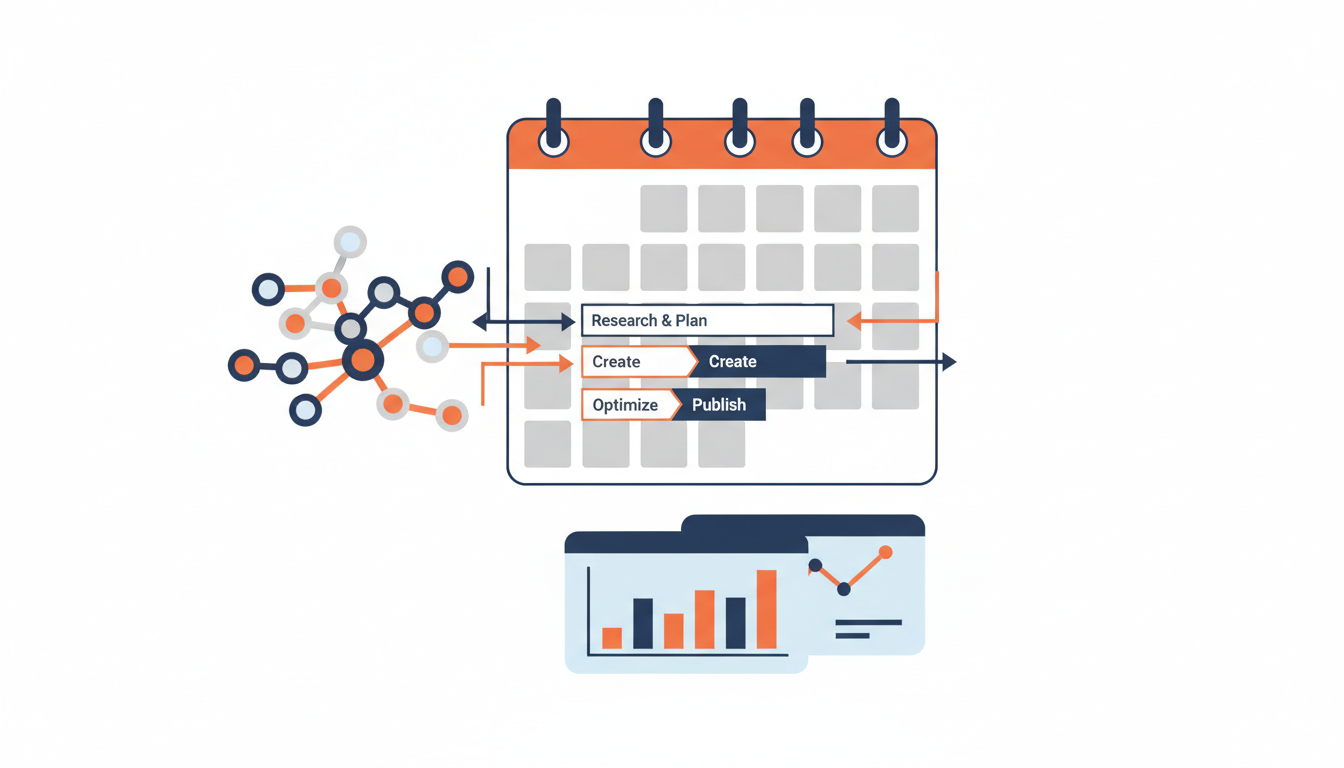
30-Day Execution Snapshot
Intent mapping, page audit, KPI baseline.
Outline-first content and BOFU alignment.
Publish with internal-link reinforcement.
Optimize based on qualified lead signals.
Week 1: Build the foundation before touching volume
1) Define one commercial outcome for the month
Do not start with “we need more traffic.” Start with a business target: for example, more qualified consultation calls for one service. Then reverse-calculate supporting metrics: required leads, expected conversion rate, and target cost per qualified lead.
This prevents the most common mistake: producing content that gets impressions but no business impact.
2) Pick one service cluster and one internal-link destination
Choose one high-value service area (for example SEO consulting, content strategy, or performance marketing). Make one existing service page your core destination. Every support article you publish this month should naturally feed authority and context to that page.
On Media87, the right routing pattern is to support service intent pages like Services with practical, decision-helpful content, not broad trend summaries.
3) Run an intent audit on existing pages
For each page in your selected cluster, ask:
- What exact query intent does this page target?
- Does the title and opening answer that intent directly?
- Is there a clear next step (CTA) for a serious buyer?
- Does this page link to the right commercial destination?
If two pages target the same intent, merge or retarget one. Intent cannibalization slows results and confuses search engines.
4) Prepare your quality gates before publishing anything
Create a pre-publish gate that checks: one H1 only, useful H2 structure, TL;DR near top, FAQ, internal links, alt text, and readability on mobile. AI content without a gate is where quality falls apart.
Week 2: Build useful content that supports money pages
1) Use outline-first production
Before drafting, build an outline that mirrors real search intent:
- What the reader wants to solve now
- What options exist
- How to evaluate options
- What to do next
This gives the article decision value, not just informational padding.
2) Produce one anchor article + two support pieces
In a 30-day cycle, a practical cadence for SMEs is:
- One anchor article (deep and practical)
- One MOFU support article (evaluation/comparison angle)
- One BOFU support article (pricing/process/implementation angle)
All three should map back to one service destination through natural internal anchors.
3) Make the article genuinely useful
Useful content for buyers includes specifics: workflow steps, implementation examples, risk points, timelines, and expected trade-offs. Generic phrases like “stay ahead of competition” add no value. If a paragraph does not help a reader decide or act, remove it.
4) Add local context deliberately
Dubai buyers often evaluate speed, trust, and clarity quickly. Your content should reflect this through practical sections such as turnaround expectations, communication process, and what “good delivery” looks like in your category. Mentioning relevant contexts (without keyword stuffing) improves conversion quality.
Week 3: Publish, interlink, and strengthen local trust signals
1) Publish in clean Gutenberg-safe structure
Use real heading blocks and list blocks. Avoid publishing raw markdown symbols by accident. Structure quality affects both user trust and SEO clarity.
2) Add strategic internal links
Each new article should include 3–5 contextual internal links:
- At least one to the primary service destination
- One to a closely related supporting resource
- One to a relevant proof or implementation page
For example, if the reader needs practical execution context, linking to pages like AI video creation service or implementation-focused posts such as geo-tagging images for SEO can help when contextually appropriate.
3) Strengthen local SEO trust layer
For SMEs targeting local demand, do not ignore Google Business Profile quality and consistency. Keep core business details complete, keep service messaging aligned with landing pages, and respond to inquiries quickly. Content can attract clicks, but trust signals convert clicks into conversations.
4) Improve visual comprehension, not decoration only
Use visuals to explain frameworks and workflows. One visual near the top and one in the middle/bottom helps scanning, especially on mobile. Each image needs descriptive alt text and clean dimensions for performance and readability.
Week 4: Measure, optimize, and scale carefully
1) Review qualified performance, not raw traffic alone
By week 4, you should know whether the content is attracting the right audience. Focus on qualified actions: consultation requests, meaningful form submissions, and high-intent messages. If traffic rises but lead quality falls, your intent mapping is weak.
2) Improve underperforming sections first
Instead of rewriting everything, patch specific weak areas:
- Clarify opening answer within first 100 words
- Tighten headings to match intent language
- Add missing comparison/process detail
- Improve CTA clarity and placement
Small structural fixes often outperform big rewrites.
3) Scale only after repeatable quality
If one 30-day cycle performs well, scale gradually: add adjacent intent clusters and repeat the same quality gate. Do not jump from 3 articles to 15 without maintaining review discipline.
Priority Matrix (Fast Wins First)
| Task | Impact | Effort | Priority |
|---|---|---|---|
| Fix service page message + CTA | High | Medium | 1 |
| Add one BOFU support article | High | Medium | 2 |
| Strengthen internal links | Medium | Low | 3 |
Rule: If a task does not improve qualified leads, rewrite or remove it.
KPI framework for practical decision-making
Use this simple framework to avoid vanity reporting:
Acquisition KPIs (weekly)
- Organic impressions for target cluster
- Organic click-through rate on priority pages
- Landing-page engagement quality
Conversion KPIs (weekly)
- Qualified leads from organic sources
- Lead-to-opportunity rate
- Response speed for inbound leads
Business KPIs (monthly)
- Cost per qualified lead
- Revenue influenced by organic content
- Pipeline quality from target service clusters
Decision rule: if impressions grow but qualified leads do not, improve intent alignment and on-page decision clarity before publishing more volume.
Common mistakes that reduce article quality
- Publishing first drafts: no second-layer review for usefulness and factual clarity.
- Topic duplication: multiple posts attacking the same query intent.
- Weak internal routing: articles not linked to money pages.
- Generic language: no practical examples, no implementation detail.
- No local context: content that could belong to any market.
- Vanity KPI obsession: celebrating traffic while sales quality drops.
30-day implementation checklist
- Define one commercial objective for the month.
- Select one service cluster and one primary internal-link destination.
- Audit existing pages for intent overlap and fix cannibalization.
- Create outline-first briefs before drafting.
- Publish one anchor article + two support pieces with clear intent split.
- Apply pre-publish gate (structure, usefulness, links, images, FAQ, CTA).
- Add two practical visuals with proper dimensions and descriptive alt text.
- Track qualified leads and conversion quality weekly.
- Patch weak sections before increasing output volume.
- Scale only when quality and results are both stable.

Conclusion
AI SEO for Dubai SMEs works when it is treated as a disciplined operating system, not a content shortcut. A focused 30-day cycle—intent mapping, service-page support, quality-gated publishing, and KPI-led optimization—creates compounding results. If you execute this sequence consistently, you will build both search visibility and lead quality without wasting budget on content noise.
Frequently Asked Questions
1) Is AI SEO worth it for small teams?
Yes, if you use AI to accelerate process steps and keep humans responsible for strategy, factual integrity, and conversion logic.
2) Should we publish more or improve existing pages first?
Improve high-intent service pages first. Then publish supporting content that strengthens those pages through internal links.
3) How many articles should we publish in 30 days?
For most SMEs, one strong anchor article plus two support pieces is a practical quality-first baseline.
4) What is the biggest mistake in AI-assisted content?
Publishing generic first drafts with no quality gate. This creates traffic noise and weak buyer trust.
5) Which metric matters most?
Qualified leads from organic content. Impressions and clicks are useful signals, but they are not the business outcome.
6) When should we scale content volume?
Scale only after one full cycle shows stable quality, clear intent coverage, and measurable business impact.