
AI voices have improved massively — but most people still use them the wrong way.
They paste a script into ElevenLabs, click “Generate,” and wonder why it sounds robotic, rushed, flat, or unnatural.
Here’s the truth:
✅ The voice model is only half the story.
✅ The performance direction inside the script is what creates “ultra-human” voice quality.
In this article, I’ll show you a simple but powerful method to create ultrahuman-style voices by using ChatGPT to rewrite your script into a performance-ready version designed for ElevenLabs.
This method adds:
- natural pauses
- emotion shifts
- emphasis
- breath cues
- conversational pacing
- and voice direction
The result? Your AI voice suddenly sounds like a real person with intention — not a machine reading text.
Why Most AI Voices Sound Fake (Even with a Great Voice Model)
Even the best AI voice models fail when:
- the script has no pauses
- sentences are too long
- there’s no emotional intention
- the pacing is uniform
- the language is too “written” and not “spoken”
- transitions are abrupt
- emphasis is missing
Humans don’t talk like blog posts.
We speak in:
✅ fragments
✅ micro-pauses
✅ emotional variations
✅ rhythm and tension
✅ emphasis and softness
So the key is: rewrite the script into spoken language + performance cues.
The Method: Script → ChatGPT Performance Rewrite → ElevenLabs
Here’s the workflow:
Step 1: Start with a normal script
This could be:
- a YouTube voiceover
- Instagram reel narration
- ad script
- educational content
- product explanation
Step 2: Send the script to ChatGPT using a specific prompt
ChatGPT will convert it into a voice-performance script.
Step 3: Paste the output into ElevenLabs
ElevenLabs will interpret the structure and cues and sound much more natural.
The “Ultra-Human Voice Prompt” (Copy-Paste)
Use this prompt in ChatGPT:
You are a professional voice director and script editor.

Your job is to rewrite the following script into an ultra-human voiceover version designed for ElevenLabs.

Rules:
1) Convert written text into spoken, conversational language.
2) Add natural pauses using: (pause 0.3s), (pause 0.5s), (pause 1s)
3) Add emotional direction in brackets like:
   [warm], [excited], [serious], [calm], [curious], [confident], [soft], [urgent]
4) Add emphasis using ALL CAPS for important words (but not too often).
5) Add small human-like fillers sparingly (like “you know,” “honestly,” “right?”) — but only where natural.
6) Break long sentences into shorter, voice-friendly lines.
7) Add breath cues occasionally: (breath)
8) Keep the meaning the same, but make it SOUND like a real person is speaking it.
9) Output ONLY the rewritten voiceover script. No extra explanations.

Script:
---
[PASTE SCRIPT HERE]
---
✅ This prompt is your “secret sauce.”
It transforms boring text into performance-level speech.
Example: Normal Script vs Ultra-Human Script
✅ Original Script (Robotic)
“In today’s video, we will discuss how to increase productivity by using automation tools and minimizing distractions.”
✅ Ultra-Human Output (ElevenLabs Ready)
[confident] In today’s video… (pause 0.5s)
I want to show you something that can instantly make you more productive.
(pause 0.3s)
And honestly — it’s not about working harder.
It’s about working SMARTER. (pause 0.5s)
Using automation… and removing distractions.
(pause 0.3s)
Let’s break it down.
Notice what changed:
- pacing
- emotion
- emphasis
- pauses
- energy shifts
That’s what makes it sound human.
Pro Tips: How to Make Voices Sound EVEN More Real
Here’s the advanced layer — what Media87 uses when we produce high-quality AI voice content.
1) Add “micro-moments”
Humans do this naturally:
- “Wait…”
- “Here’s the crazy part…”
- “Let me explain…”
- “This matters because…”
These create storytelling realism.
2) Use contrast in tone
Example:
- start calm
- build suspense
- land with confidence
- end with warmth
AI voices sound robotic when the tone never changes.
3) Use intentional silence
Silence is power.
Use:
- (pause 1s) before key points
- (pause 0.5s) after a punchline
- (pause 0.3s) between short phrases
4) Add “breath” like a human performer
Not too much. Just occasionally:
- (breath)
- [soft] …and that’s why this works.
5) Use “spoken grammar”
Instead of:
❌ “Therefore, we recommend implementing…”
Use:
✅ “So here’s what I’d do…”
What to Do in ElevenLabs (Best Settings)
ElevenLabs voices vary, but here’s a strong starting point:
✅ Stability: Medium-low (so it feels expressive)
✅ Similarity: Medium-high (so the voice stays consistent)
✅ Style / Expressiveness: Medium-high
✅ Speaker Boost: On (if it improves clarity)
Then adjust based on content type:
For Ads / Promos:
- More expressiveness
- sharper pauses
- stronger emphasis
For Educational / Explainer:
- calmer tone
- fewer fillers
- clean pauses
Common Mistakes to Avoid
Here are mistakes that instantly ruin “ultra-human” voice quality:
❌ Using too many pauses → sounds dramatic and fake
❌ Adding too many emotions → becomes unnatural
❌ Overusing ALL CAPS → feels forced
❌ Using “(laugh)” or “(cry)” too often → cringe
❌ Keeping paragraphs too long
❌ Too many filler words
Keep it subtle — realistic humans are not theatrical.
The Media87 Way: We Turn AI Voices into Professional Narration
At Media87.com, we help brands, creators, and businesses build high-converting content systems using AI — and voice is one of our most powerful tools.
✅ We don’t just generate voice.
We produce voiceovers that sound like real presenters, designed to hold attention and drive action.
What Media87 Can Do for You
- AI voiceover production (ultra-human style)
- script writing + rewriting for voice performance
- reels + YouTube automation content systems
- ad creatives using AI narration
- voice cloning (where permitted)
- storytelling format design (hooks, suspense, payoff)
- complete content workflow creation
If you want your content to sound premium and natural — we can build the full pipeline for you.
Final Thoughts
If you want ultra-human AI voices, don’t chase voice models.
✅ Chase performance scripting.
Because when the script sounds human… the voice becomes human.
And the fastest way to do it is:
Script → ChatGPT performance rewrite → ElevenLabs
Try it once, and you’ll never go back.
- This update keeps the original angle of How to create ultra realistic human sound voice with prompting and adds a clearer decision framework, practical checklist, FAQs, and conversion-focused next steps.
- Readers should leave with a better understanding of what to do first, what to avoid, and when to ask for expert support.
- The guidance is additive only: title, slug, and core angle are preserved.

How to use this guide in practice
Treat this article as a starting point, then connect the advice to your business model, customer journey, and current marketing stack. A useful implementation plan should identify the outcome, the first action, the owner, the metric, and the point where the work needs expert review. For broader support, compare the recommendation with Media87 digital marketing services at Media87.
The practical way to use a tutorial like this is to separate inspiration from implementation. Inspiration helps you see what is possible; implementation decides who will own the process, which tool will be used, what quality standard is acceptable, and how the final output will be checked before it reaches customers or the public. That difference matters because many AI and automation workflows look impressive in a demo but fail when they meet real brand rules, customer expectations, and repeatable delivery needs.
| Decision area | Practical check | Risk to avoid |
|---|---|---|
| Goal | Define the commercial result before choosing tools or tactics. | Doing activity that does not connect to leads, sales, retention, or trust. |
| Workflow | Break the work into a simple first version, then improve it monthly. | Building a complex system before proving the basics. |
| Quality control | Review outputs against brand tone, accuracy, privacy, formatting, and user experience before publishing or sending. | Letting automation create public-facing mistakes at scale. |
| Measurement | Track a small set of useful KPIs and review them regularly. | Reporting vanity metrics without decisions attached. |
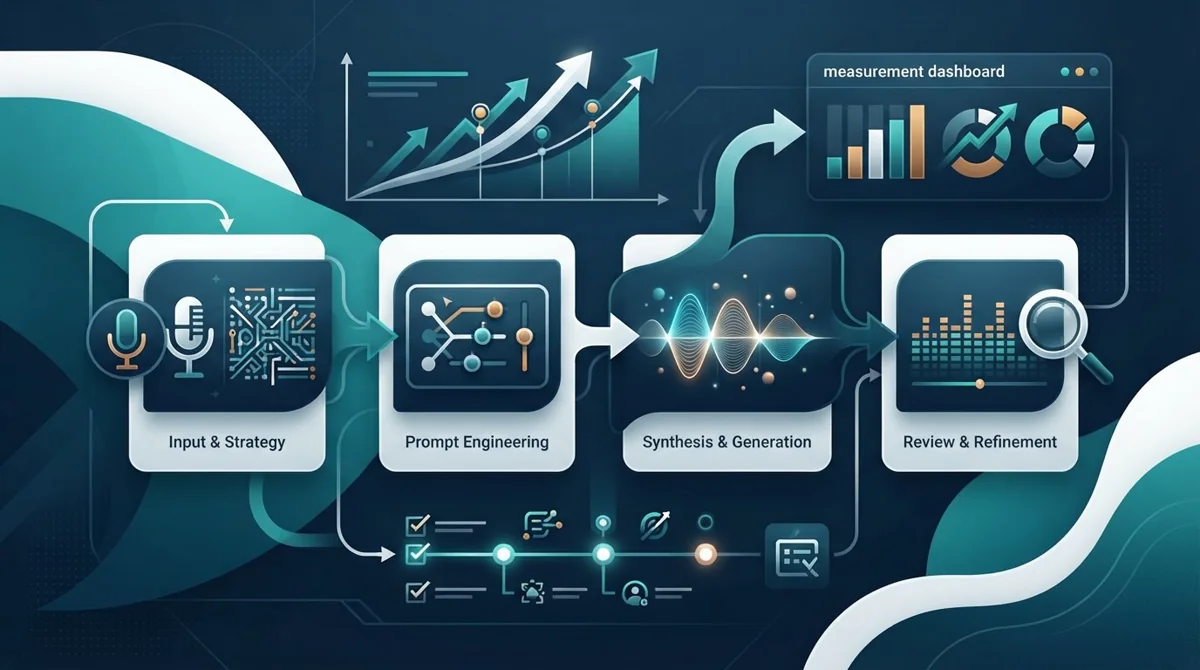
A simple execution workflow
Write one sentence describing the business problem, the audience, and the desired output. If the use case cannot be explained simply, narrow it before adding tools.
Create a small repeatable workflow with clear inputs, outputs, ownership, and review steps. Avoid connecting every system until the basic process works.
Check examples, record common failures, and improve prompts, templates, handoff rules, or tracking before scaling the workflow.
For AI-assisted production, the review step should never be skipped. Check whether the output is accurate, whether it sounds like the brand, whether it includes unsupported claims, whether private information is exposed, and whether a customer would understand the next step. If the workflow touches sales, support, email, ads, or website content, add a human approval point until the process has proved reliable.
Common mistakes to avoid
The first mistake is using a tool because it is trending rather than because it solves a defined business problem. Start with the bottleneck: slow replies, weak content quality, inconsistent follow-up, poor reporting, repetitive design work, or missed enquiries. Then choose the smallest workflow that improves that bottleneck.
The second mistake is treating prompts as permanent. Prompts should evolve as you see real outputs. Keep examples of good results, bad results, edge cases, and brand corrections. Over time, that small library becomes more valuable than a generic prompt copied from the internet.
The third mistake is scaling before measurement. Before automating more volume, define what success means: faster turnaround, more qualified enquiries, fewer manual steps, better content consistency, lower production cost, or improved customer response time. If the metric is unclear, the automation can look busy while producing little business value.
Practical checklist before using this workflow
- What exact problem does this solve for the business or customer?
- Which inputs are required, and who is responsible for providing them?
- What should a good output look like? Save one or two examples.
- What must never appear in the output: wrong claims, private data, fake guarantees, off-brand tone, or unreadable visuals?
- Where does human review happen before public use?
- Which KPI will be checked after the workflow runs for one month?
- What is the fallback if the tool fails, returns poor quality, or produces unsafe output?
FAQs
What should I do first?
Start with the highest-friction step in the current workflow, then improve one measurable outcome before adding complexity.
When should I ask for help?
Ask for help when the work affects revenue, customer experience, tracking accuracy, or public brand trust.
How often should this be reviewed?
Review performance monthly and update the process when customer behaviour, platform rules, or business priorities change.
Should I automate the full process immediately?
No. Build a small version first, test it with real examples, and add automation only after quality and handoff rules are clear.
How do I keep AI output on brand?
Use approved examples, a short style guide, forbidden claims, review checkpoints, and a log of corrections so the workflow improves over time.
Need help turning this into a reliable workflow? Media87 can help plan the content, automation, SEO, tracking, and review system so useful ideas become repeatable business processes rather than one-off experiments.