

If you are asking how long SEO takes in the UAE, the honest answer is: it depends on where your website starts, how competitive your service category is, and whether the work is actually implemented every month. A restaurant trying to improve local map visibility in one neighbourhood, a B2B training company targeting corporate buyers, and a digital marketing agency competing for Dubai SEO terms will not move at the same speed. The timeline is not magic; it is the result of crawlability, content quality, internal linking, authority signals, local relevance, and how quickly search engines can test and trust the improved pages.
For UAE businesses, the practical goal should not be “rank number one by next month.” A better goal is to define what should improve in the first 30 days, what should be measurable by 90 days, what should be earning leads by 6 months, and what needs a 12-month runway. That mindset protects you from unrealistic guarantees and helps you judge an SEO provider by execution quality rather than promises.
- 0–30 days: audit, technical fixes, indexing checks, page mapping, analytics, and quick on-page improvements.
- 1–3 months: early ranking movement, stronger service pages, internal links, local SEO cleanup, and Search Console trend signals.
- 3–6 months: more stable growth for mid-competition keywords and better conversion paths.
- 6–12 months: commercial terms, content clusters, local authority, and lead quality become easier to evaluate.
- 12+ months: SEO compounds when the site keeps publishing useful pages, refreshing winners, and earning trust.

Why SEO timelines vary so much in the UAE
The UAE search market is unusually mixed. You have local service businesses competing inside Dubai neighbourhoods, regional companies targeting the whole UAE, ecommerce brands serving Arabic and English users, and international agencies competing for high-value B2B queries. Google does not rank pages because a campaign has been running for a certain number of weeks. It ranks pages when they are discoverable, relevant, useful, trustworthy, and competitive against the pages already satisfying that query.
That is why two companies can start SEO on the same day and see very different outcomes. One may already have a fast website, clear service pages, a good Google Business Profile, and some brand searches. Another may have thin pages, duplicated location content, weak technical foundations, and no authority. The first company may see early gains after improving titles, headings, internal links, and content depth. The second needs foundational repair before ranking movement means anything.
Google’s own SEO documentation is useful here because it frames SEO as making your site easier for search engines and people to understand, not as a shortcut. Its Search Essentials and SEO starter guidance emphasise crawlable pages, useful content, descriptive titles, logical links, and avoiding manipulative tactics. The same fundamentals also apply when your content can appear in AI-powered search features: pages need to be accessible, helpful, and eligible for search features before they can be used confidently.
A realistic SEO timeline framework
Use the following framework as a planning baseline. It is not a guarantee, but it is a practical way to set expectations with your internal team or agency. The more competitive the keyword, the more you should treat the right side of each range as realistic.
| Stage | Typical timeframe | What should happen | Useful KPIs |
|---|---|---|---|
| Foundation | 0–30 days | Technical audit, indexing checks, analytics setup, sitemap review, page intent mapping, metadata fixes, internal-link cleanup, local profile review. | Indexed pages, crawl errors, Core Web Vitals issues, tracking accuracy, baseline rankings, impressions. |
| Early movement | 1–3 months | Important service pages are rewritten or improved, supporting articles are published, internal links point to priority pages, local citations and GBP basics are cleaned up. | Impression growth, early ranking movement, page engagement, map visibility, clicks from long-tail terms. |
| Commercial traction | 3–6 months | Clusters start supporting service pages, mid-competition terms improve, pages begin earning more qualified visits, weak pages are refreshed based on data. | Organic leads, assisted conversions, commercial keyword positions, click-through rate, inquiry quality. |
| Compounding growth | 6–12 months | Authority, content breadth, technical health, and conversion improvements combine. More competitive Dubai and UAE terms become realistic. | Lead volume, cost per organic lead, non-brand traffic, ranking stability, pipeline contribution. |
| Market authority | 12+ months | The site has topical depth, refreshed content, strong internal linking, local trust, and a repeatable process for new opportunities. | Share of voice, qualified pipeline, ranking resilience, branded search growth, content refresh ROI. |
What can improve in the first 30 days
The first month should be about control and clarity. A serious SEO campaign starts by finding what is blocking performance: indexation problems, duplicate pages, weak service copy, missing internal links, poor local signals, thin content, slow templates, tracking gaps, or pages targeting the same intent. For UAE businesses, this stage also includes clarifying whether pages should target Dubai, Abu Dhabi, Sharjah, the whole UAE, or a specific neighbourhood such as JLT, Business Bay, Dubai Marina, or Downtown Dubai.
You may see some quick wins in this period, especially if the site already has authority and the issues are obvious. For example, a service page that had a vague title, no clear H1, weak copy, and no internal links can sometimes improve after the page is rebuilt around the real buyer intent. But those early wins should be treated as a bonus, not the main promise. The real output of month one is a clean roadmap and a site that is easier to crawl, understand, and measure.
A practical month-one deliverable should include a technical findings list, a keyword-to-page map, a list of pages to improve or merge, a content plan, Google Business Profile notes if local SEO matters, and a measurement dashboard. Without that foundation, later content production can create more cannibalisation instead of more traffic.
What to expect by 90 days
By 90 days, you should expect signals rather than final victory. Search Console impressions may rise before clicks rise. Long-tail rankings may move before competitive head terms. A few supporting pages may begin bringing relevant visitors. Your priority service pages should be better aligned with what buyers actually search for, and the site should have a clearer internal-link structure.
This is also the stage where quality control matters. If every article is generic, if pages repeat the same advice, or if the site publishes near-duplicate posts around the same keyword, the campaign may look busy but fail to build authority. The goal is not to publish a certain number of pages; it is to build a useful cluster where each page has a distinct job. A timeline article like this should support a commercial page such as SEO services in Dubai by answering a common buyer objection before a sales conversation.
If nothing has changed by 90 days — no cleaner structure, no indexing improvement, no new impressions, no better page quality, no stronger internal links — the campaign needs a diagnosis. Sometimes the issue is poor implementation. Sometimes the target keywords are too competitive for the current authority level. Sometimes the website has technical or content duplication problems that were not fixed.
What to expect by 6 months
Six months is often the point where SEO becomes easier to judge. By then, the campaign should have enough implementation history to separate normal SEO lag from weak execution. Important pages should have been improved, supporting content should be live, internal links should be deliberate, and Search Console should show whether Google is testing the site across more relevant queries.
For less competitive local or niche UAE queries, six months can be enough to generate meaningful organic enquiries. For competitive Dubai agency, real estate, legal, finance, healthcare, ecommerce, and training terms, six months may still be the middle of the journey. That does not mean SEO is failing; it means the campaign needs to show measurable progress in the right leading indicators while commercial rankings continue building.
A good SEO partner should be able to explain what improved, what did not, and what will change next. If reports only show vanity metrics such as total impressions with no connection to qualified leads, page priorities, or revenue potential, the reporting is not strong enough for decision making.
What to expect after 12 months
After a year, SEO should feel less like isolated tasks and more like an operating system. The site should have a clearer service architecture, stronger supporting articles, better internal links, improved local relevance, refreshed pages based on data, and a content process that avoids duplicate intent. This is when SEO can start compounding: older pages keep earning visibility while new pages enter a stronger site ecosystem.
However, a year of low-quality activity does not guarantee results. Publishing thin AI-written posts, ignoring technical problems, or chasing every keyword variant can waste a full year. The compounding effect comes from useful pages, consistent updates, trust signals, and a clear relationship between content and the services the business actually sells.
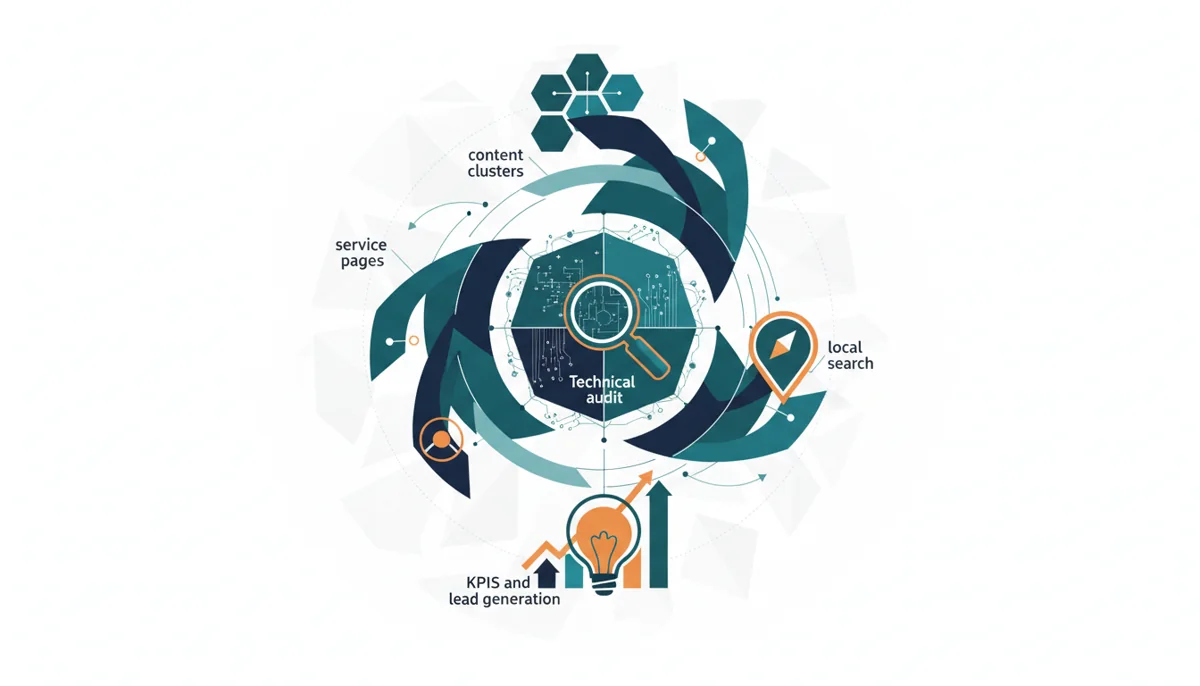
Factors that speed up or slow down SEO results
A clean, indexed, technically stable website usually moves faster than a slow, duplicated, or poorly structured site.
Dubai and UAE commercial keywords often need stronger authority, better pages, and more time than narrow long-tail queries.
Audits do not rank. Published fixes, improved pages, internal links, local updates, and refreshed content create the signals.
Pages that answer buyer questions clearly tend to outperform generic posts that repeat basic definitions.
Brand demand, quality backlinks, citations, reviews, case studies, and expert proof can all influence how competitive the site becomes.
Without Search Console, analytics, call/form tracking, and lead-quality review, you may misread progress or miss conversion issues.
Common timeline mistakes and how to fix them
| Mistake | Why it hurts | Fix |
|---|---|---|
| Expecting page-one rankings in 30 days | It creates pressure for shortcuts and makes normal SEO lag look like failure. | Set 30, 90, 180, and 365-day milestones with leading and lagging KPIs. |
| Publishing duplicate keyword variants | Multiple pages compete against each other and dilute authority. | Cluster keywords by intent and assign one canonical page per intent. |
| Ignoring service pages | Blog traffic may grow without improving commercial enquiries. | Use supporting articles to strengthen high-intent service pages and CTAs. |
| Measuring only traffic | More visitors do not always mean better leads. | Track qualified enquiries, form submissions, calls, assisted conversions, and page-level lead quality. |
| Stopping too early | SEO often begins compounding after the first round of fixes and content has been tested. | Review the data, refresh weak pages, and continue building around proven topics. |
The KPI checklist for a UAE SEO campaign
Use a balanced KPI set. Early indicators tell you whether Google is discovering and testing the site. Later indicators tell you whether SEO is helping the business. Both matter, but they should not be mixed together.
- Technical: crawl errors, index coverage, sitemap health, page speed, mobile usability, structured data issues.
- Visibility: impressions, ranking movement, non-brand query growth, pages gaining new queries.
- Engagement: click-through rate, landing page engagement, scroll depth where available, content paths.
- Commercial: enquiries, calls, WhatsApp clicks, qualified leads, assisted conversions, cost per organic lead.
- Content quality: pages refreshed, cannibalisation resolved, internal links added, FAQs improved, outdated claims removed.
- Local SEO: Google Business Profile actions, map visibility, review velocity, local landing page performance.
A practical SEO process that keeps timelines realistic
Start with a business-first SEO audit. Decide which services, locations, and audience segments matter most. Then map each keyword cluster to one destination page. For Media87 clients, this usually means strengthening commercial service pages first, then publishing supporting articles that answer buyer questions and link naturally back to the relevant service page.
Next, fix technical blockers and improve the pages that already have the best chance of ranking. After that, publish new content only when it has a clear job: support a service, answer a real question, compare options, explain cost, reduce objections, or capture a useful local intent. A good campaign also refreshes older pages because SEO performance changes as competitors update their content and search behaviour shifts.
Finally, review the data monthly. If a page is gaining impressions but not clicks, improve the title, meta description, and snippet clarity. If a page earns traffic but no leads, improve the CTA, proof, internal links, and offer match. If multiple pages overlap, merge or retarget them instead of adding yet another article. This is how timelines become manageable: each month has a diagnosis, an action, and a measurement point.
When should you worry that SEO is taking too long?
You should worry if the campaign has no clear roadmap, no implemented fixes, no Search Console trend review, no service-page improvements, and no explanation of what is being tested. SEO takes time, but “SEO takes time” should not be used as an excuse for vague work. By 90 days, you should see evidence of implementation and early signals. By 6 months, you should have enough data to judge whether the strategy is moving in the right direction.
You should not panic simply because the most competitive keyword has not reached page one. Competitive commercial SEO in the UAE often takes sustained work. The better question is whether the site is earning more relevant impressions, improving page quality, answering buyer questions better than before, and moving users toward real enquiries.
Useful sources and further reading
- Google Search Central: SEO Starter Guide
- Google Search Essentials
- Google Search Central guidance on AI features and your website
- Ahrefs: How long does SEO take?
- Semrush: How long does SEO take?
FAQ
Can SEO work in 30 days?
Some fixes can show early movement in 30 days, especially on an established site, but reliable SEO growth usually needs several months. Month one should focus on audit, technical fixes, page mapping, and quick on-page improvements.
How long does local SEO take in Dubai?
Local SEO can show useful movement in 1 to 3 months when the business has a complete Google Business Profile, accurate citations, reviews, and strong local landing pages. Competitive local niches may still need 6 months or more.
Why does a new website take longer to rank?
A new site has less history, fewer trust signals, fewer links, and less performance data. Search engines need time to discover, crawl, test, and compare the site against established competitors.
Should I run Google Ads while waiting for SEO?
Often yes. Paid search can generate leads while SEO compounds. The best mix depends on margins, competition, sales cycle, and whether landing pages are ready. You can also use ad data to learn which queries convert before investing heavily in SEO content.
How do I know if my SEO agency is doing good work?
Look for clear diagnosis, implemented fixes, useful content, internal linking, transparent reporting, and business-relevant KPIs. Avoid providers who only report rankings without explaining leads, page quality, or next actions.
Can SEO results disappear?
Yes. Competitors update pages, Google systems change, technical issues appear, and content becomes outdated. Ongoing monitoring, refreshes, and quality control help protect rankings.
Media87 can audit your current site, map the quickest opportunities, and build a practical 30/90/180-day SEO roadmap around your services, market, and lead goals. Start with our SEO services in Dubai or explore broader digital marketing services in Dubai.